

Chichibu Joraku-ji Temple
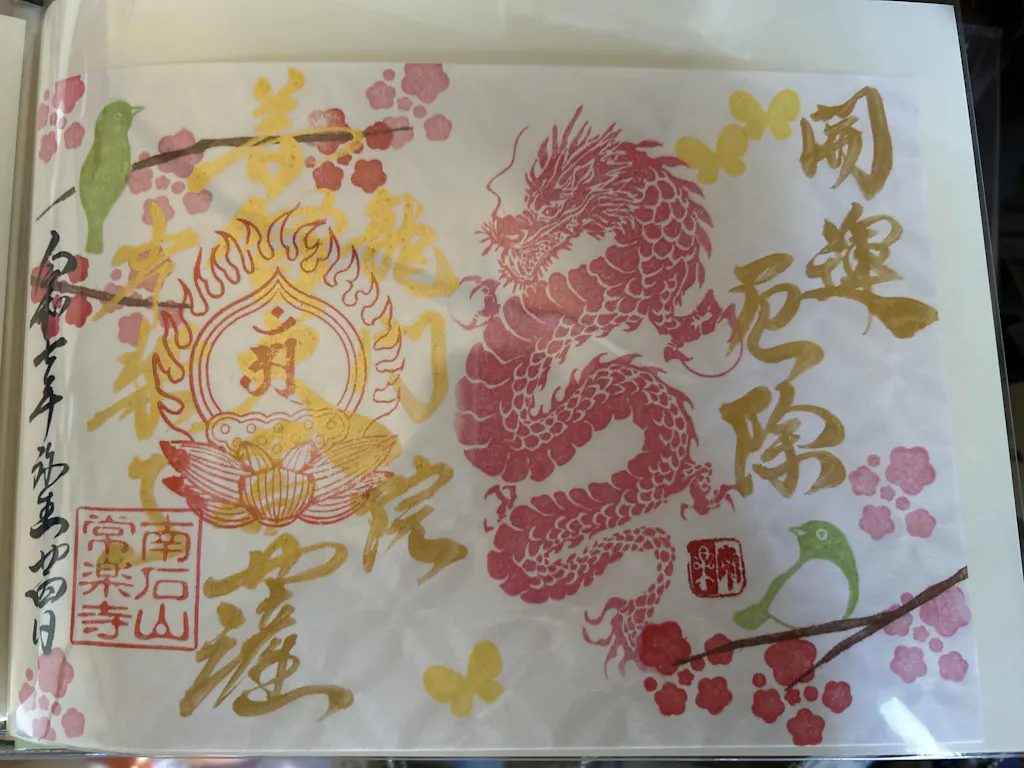
[Chichibu, Saitama: Jorakuji Temple] Exhibition: Special Goshuin Dragon Series March "Dragon, Plum Blossoms, and White-eye"
[Chichibu, Saitama: Jorakuji Temple] Exhibition: Special Goshuin Dragon Series March "Dragon, Plum Blossoms, and White-eye"
Couldn't load pickup availability
Distributed monthly at Jorakuji Temple
Special Goshuin "Dragon Series"
March is "Dragon and " Plum blossoms and white-eye ."

※The day of the Dragon will be written in gold letters.※
How do I apply for gold letters?
March Dragon Day🐲: March 12th (Wednesday), March 24th (Monday)

How do I apply for advance reservations?

The thoughts behind the special goshuin

In the soft sunlight of early spring,
A white-eye has landed on a plum branch and is singing beautifully under the protection of a dragon.
Since ancient times, plum blossoms have been a symbol of the five blessings and are believed to ward off evil spirits.
The appearance of the white-eye brings peace and tranquility.
The scene is like the teachings of Buddha.
It is as if they are telling us the joy of life and the arrival of spring. 
From bud to flower,
And as the plum blossoms turn into fruit,
I feel the change of seasons and new beginnings.
The wind of happiness carried by the white-eye
Like the compassionate heart of Bodhisattva Samantabhadra,
It gently envelops the hearts of all who visit.
This goshuin has the following:
To each and every visitor,
Like the good fortune brought by the white-eye,
Wishing you a bright spring
We hope that this will help you.

You can choose your benefits
Please write down your desired benefits.
・Increased financial luck
・Good luck and protection from evil
・Wish fulfillment
・Household safety
・Physical health
Please choose from:
I will carefully write each one.
Two white-eyes herald the arrival of spring

White-eyes, which visit plum blossoms in early spring, are messengers announcing the arrival of spring. Their adorable appearance is a symbol of peace and tranquility, and it is said that if one comes near a home, the family's fortunes will improve. White-eyes, which bring good fortune and peace of mind, are an auspicious motif that is also connected to the benefits of "peace of mind" of Fugen Bodhisattva.
Beautifully blooming plum blossoms

Plum blossoms, which symbolize the five blessings, are said to have the power to ward off evil spirits and bring good fortune, as they endure the harsh cold and bloom in early spring. The vitality that makes the flowers bloom so powerfully is linked to the good fortune that the dragon at Jorakuji Temple bestows upon us, and we have incorporated this wish for new good fortune to come our way.
The butterfly of luck is fluttering

The bright yellow butterfly is a symbol of life, beginning to dance with the arrival of spring. Butterflies represent change and rebirth, and their appearance as they awaken from their winter slumber and take flight represents new beginnings and hope. Their light, airy dance is said to brighten the spirit and bring happiness.
Jorakuji Temple's Dragon Seal

Dragons have been worshipped as guardian deities since ancient times.
It is said to have the power to ward off evil and bring peace of mind.
It is placed next to the Adonis flower and the Seal of Light, and will protect the wishes of those who visit with purity.
The characters for "Samantabhadra Great Bodhisattva"

Samantabhadra Bodhisattva is a bodhisattva who guides people with wisdom and compassion, bringing them peace of mind.
I write this letter with the hope that it will grant you a pure heart and daily peace.
Sanskrit seal "An"

A sacred seal with Sanskrit characters written inside a jewel.
Sanskrit is a writing system that originated in ancient India, and each character represents the power of Buddha.
Beautiful cloisonné-patterned washi paper

The carefully crafted cloisonné pattern subtly changes appearance depending on how the light hits it, adding depth to the goshuin seal.
The smooth texture beautifully absorbs ink and red seals, and is finished to last a long time along with spring prayers.
Bring the blessings of spring and Shippo to your goshuincho.
This is a piece that you should definitely pick up.
It is also chosen as a gift

It is also recommended as a gift for family and friends.
The date of the application is included, so it makes a great gift for birthdays or births.

Goshuin is a way to connect with gods and Buddhas
Originally it was a receipt for submitting a copy of a sutra, but now it is widely accepted as proof of worship.
This is a symbol of the faith of the worshippers and has the important meaning of connecting them with the gods and Buddhas.
The red seal is a handprint to paradise
The origin of goshuin is said to date back to the Heian period.
The origin of the goshuin is said to be that at that time, temples would give them to worshippers as proof that they had dedicated a sutra (a copy of a sutra).
The goshuin stamps are stamped with the name of the temple and the seal of the principal image, and are treasured as a memento of worship and proof of faith.
The goshuincho is also said to be a "handprint to paradise."
It is said that if you show your goshuin at Enma's judgment hall, you will be able to pray for going to paradise.
For this reason, in some areas, when a person dies, a goshuincho (stamp book) is placed in the coffin.
Is there any benefit to mailing it?
The goshuin stamps you receive by mail also reflect your own faith.
Of course, it's best to actually visit the shrine.
However, there are some people who find it difficult to come due to various circumstances.
In such cases, you can deepen your connection with the gods and Buddhas even if you are far away by applying for a goshuin by mail.
When you receive a goshuin stamp that has been written with love at a temple or shrine, it is important to offer a prayer in your heart.
It is not the goshuin itself that brings good fortune, but the heart that offers prayer that brings good fortune.
Continuing from the Edo period Like a substitute
A daisan is when someone visits a shrine or temple on behalf of someone who is unable to make the pilgrimage due to old age, illness, or busy schedule.
This tradition has continued since the Edo period.
The same applies to receiving a goshuin by mail.
At Jorakuji Temple, the head priest and all the staff will pray wholeheartedly for those who are unable to visit, so please rest assured.
With the head priest!
Visit Jorakuji Temple online
*Please be careful of the volume as sound will suddenly come on.


![[Chichibu, Saitama: Jorakuji Temple] Exhibition: Special Goshuin Dragon Series March "Dragon, Plum Blossoms, and White-eye"](http://goshuinchou.com/cdn/shop/files/1_edf67744-30af-4afc-9f05-3952e1004ee9.jpg?v=1741575604&width=1445)
![[Chichibu, Saitama: Jorakuji Temple] Exhibition: Special Goshuin Dragon Series March "Dragon, Plum Blossoms, and White-eye"](http://goshuinchou.com/cdn/shop/files/2_6c8e403f-ab3b-4080-a5d8-572f4a0eb7d0.jpg?v=1741575604&width=1445)
![[Chichibu, Saitama: Jorakuji Temple] Exhibition: Special Goshuin Dragon Series March "Dragon, Plum Blossoms, and White-eye"](http://goshuinchou.com/cdn/shop/files/3_5e7d429c-edf9-4b5b-9f84-47d1c4eacd1e.jpg?v=1741575604&width=1445)
![[Chichibu, Saitama: Jorakuji Temple] Exhibition: Special Goshuin Dragon Series March "Dragon, Plum Blossoms, and White-eye"](http://goshuinchou.com/cdn/shop/files/4_de503b3f-6fcc-4814-bb2c-888c2933bfdd.jpg?v=1741575604&width=1445)
![[Chichibu, Saitama: Jorakuji Temple] Exhibition: Special Goshuin Dragon Series March "Dragon, Plum Blossoms, and White-eye"](http://goshuinchou.com/cdn/shop/files/5_372637de-4198-4040-bdff-c455b938fe43.jpg?v=1741575604&width=1445)
![[Chichibu, Saitama: Jorakuji Temple] Exhibition: Special Goshuin Dragon Series March "Dragon, Plum Blossoms, and White-eye"](http://goshuinchou.com/cdn/shop/files/6_73371b0f-dc6c-44f9-aea2-fae1138f60b4.jpg?v=1741575604&width=1445)
![[Chichibu, Saitama: Jorakuji Temple] Exhibition: Special Goshuin Dragon Series March "Dragon, Plum Blossoms, and White-eye"](http://goshuinchou.com/cdn/shop/files/7_c8b5d176-6607-4834-8d2b-c8447267beb0.jpg?v=1741575604&width=1445)
![[Chichibu, Saitama: Jorakuji Temple] Exhibition: Special Goshuin Dragon Series March "Dragon, Plum Blossoms, and White-eye"](http://goshuinchou.com/cdn/shop/files/8_504b976d-a814-4c8c-8e84-3454670b2fe8.jpg?v=1741575604&width=1445)
![[Chichibu, Saitama: Jorakuji Temple] Exhibition: Special Goshuin Dragon Series March "Dragon, Plum Blossoms, and White-eye"](http://goshuinchou.com/cdn/shop/files/9_ca2fe9f6-ab40-4786-96c7-27bbeab1eb33.jpg?v=1741575604&width=1445)
![[Chichibu, Saitama: Jorakuji Temple] Exhibition: Special Goshuin Dragon Series March "Dragon, Plum Blossoms, and White-eye"](http://goshuinchou.com/cdn/shop/files/10_f1d26d0d-4c7c-434b-a5dd-0917cb166278.jpg?v=1741575604&width=1445)
![[Chichibu, Saitama: Jorakuji Temple] Exhibition: Special Goshuin Dragon Series March "Dragon, Plum Blossoms, and White-eye"](http://goshuinchou.com/cdn/shop/files/11_7f158eeb-ec9e-4be9-9227-f2d65a668754.jpg?v=1741575604&width=1445)
![[Chichibu, Saitama: Jorakuji Temple] Exhibition: Special Goshuin Dragon Series March "Dragon, Plum Blossoms, and White-eye"](http://goshuinchou.com/cdn/shop/files/10_e384ebfb-d811-4d4c-a427-f9b43922fe60_lang-ja.jpg?v=1783160031&width=1445)
This month's special Goshuin (temple stamp)
-
Special Goshuin for July–August “Dragon and Sunflowers – Evening Cool”
Regular price ¥1,500Regular priceUnit price per -
Special Goshuin for July–August (Limited) “Dragon and Sunflowers – Evening Cool” Gold & Black 2-Sheet Set
Regular price ¥3,000Regular priceUnit price per -
Year of the Horse Eleven-Faced Kannon – Amulet for Protection, Healing, and Longevity –
Regular price ¥1,500Regular priceUnit price per


View previous special Goshuin (temple stamp)
-
[Chichibu, Saitama: Jorakuji Temple] Exhibition: Special Goshuin Dragon Series March "Dragon, Plum Blossoms, and White-eye"
Regular price From ¥1,000Regular priceUnit price per -
[Chichibu, Saitama: Jorakuji Temple] Exhibition: September Special Goshuin Dragon Series "Moon Viewing with Dragon and Moon Rabbit"
Regular price ¥1,000Regular priceUnit price per -
[Chichibu, Saitama: Jorakuji Temple] Exhibition: August Special Goshuin Dragon Series "Dragon, Lotus, and the Sound of Wind Chimes"
Regular price ¥1,000Regular priceUnit price per -
[Chichibu, Saitama: Jorakuji Temple] Exhibition: June Special Goshuin Dragon Series "Dragon and Hydrangea"
Regular price ¥1,000Regular priceUnit price per
![[Chichibu, Saitama: Jorakuji Temple] Exhibition: Special Goshuin Dragon Series March "Dragon, Plum Blossoms, and White-eye"](http://goshuinchou.com/cdn/shop/files/1_edf67744-30af-4afc-9f05-3952e1004ee9.jpg?v=1741575604&width=533)
![[Chichibu, Saitama: Jorakuji Temple] Exhibition: September Special Goshuin Dragon Series "Moon Viewing with Dragon and Moon Rabbit"](http://goshuinchou.com/cdn/shop/files/2_051d58dd-8f44-4f4e-8384-ff957960064e.png?v=1734418735&width=533)
![[Chichibu, Saitama: Jorakuji Temple] Exhibition: August Special Goshuin Dragon Series "Dragon, Lotus, and the Sound of Wind Chimes"](http://goshuinchou.com/cdn/shop/files/2024-07-28_2__2.jpg?v=1734418735&width=533)
![[Chichibu, Saitama: Jorakuji Temple] Exhibition: June Special Goshuin Dragon Series "Dragon and Hydrangea"](http://goshuinchou.com/cdn/shop/files/6.png?v=1734418735&width=533)