

Jyoraku-ji Temple
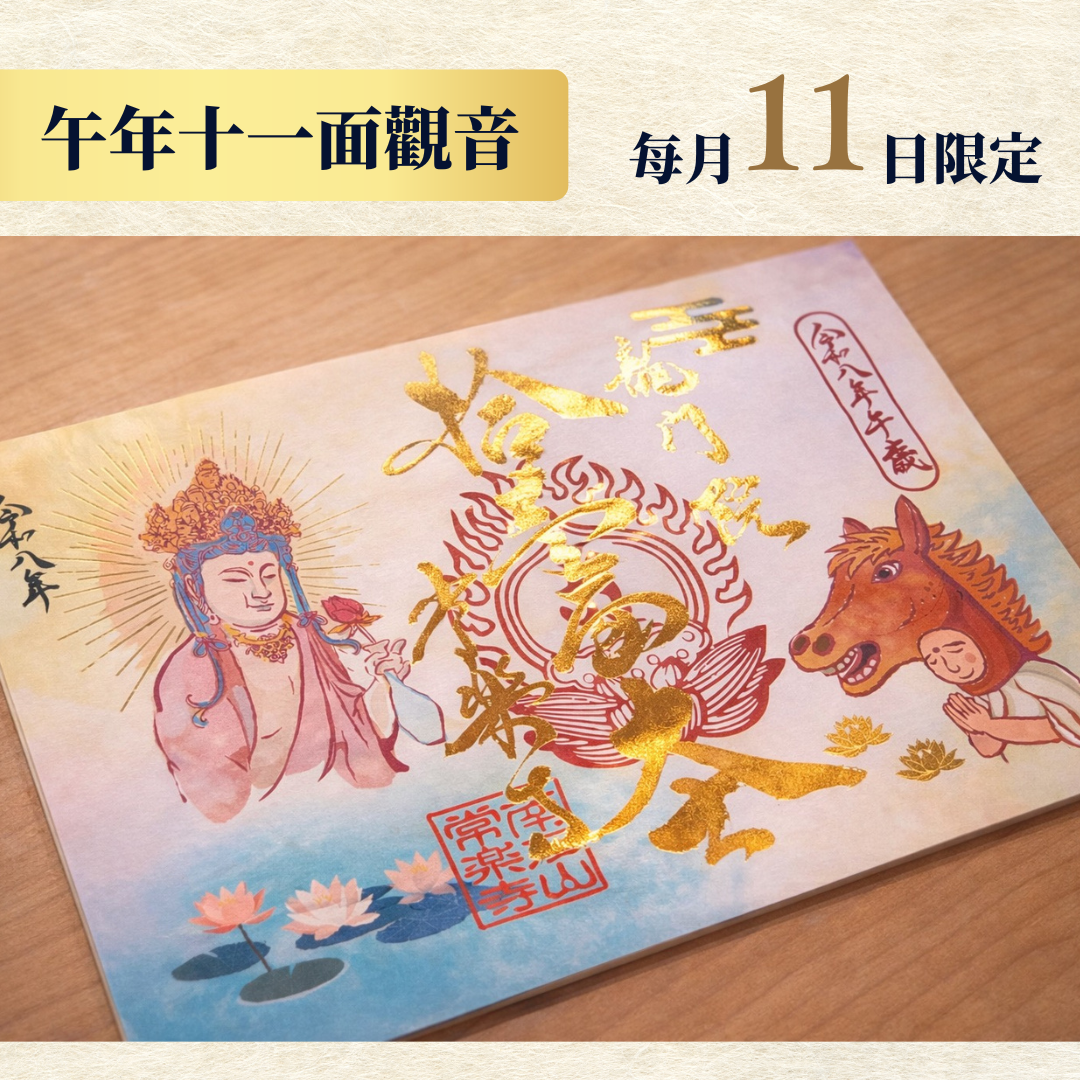
Year of the Horse Eleven-Faced Kannon – Amulet for Protection, Healing, and Longevity –
Year of the Horse Eleven-Faced Kannon – Amulet for Protection, Healing, and Longevity –
Couldn't load pickup availability
\Reborn in 2026, the Year of the Horse/
Juichimen Kannon is a revered Buddha symbolizing compassion and salvation in all directions.
This goshuin faithfully reproduces the Eleven-Faced Kannon enshrined at Jyoraku-ji Temple.
Mystical protection woven by compassionate eyes
February 11, is a Dragon Day.
On Dragon Days only, this monthly special goshuin is written in gold ink.
Please also consider:
Also currently accepting reservations for:
Blessed Goshuin & Chichibu Grand Opening Commemorative Set for the powerful auspicious day of March 5 and the Chichibu Grand Opening from March 18.
▶︎▶︎▶︎ "Chichibu Sōkaichō (Great Opening) Special Goshuin Set"
Jyoraku-ji Temple carries a long history of deep faith.
It is said that when the temple’s founder, Monk Monkai, fell gravely ill, he received a divine revelation from Kongoshin in a dream and miraculously recovered.
Since then, Juichimen Kannon has been revered as the principal deity who heals illness and grants long life.
The compassionate gaze from the eleven sacred faces sees suffering from every direction and extends a saving hand.
This all-encompassing protection dispels misfortune, supports recovery from illness, and blesses devotees with healthy longevity.
Three Major Blessings
【Protection from Misfortune】
The eleven compassionate faces perceive calamities from all directions, dispel negativity, and illuminate a pure path.
They guard against daily obstacles and bring safety and peace.
【Healing from Illness】
Since ancient times, Juichimen Kannon has been believed to heal those suffering from illness.
Their compassionate gaze soothes both body and mind, restoring health and vitality.
【Prayer for Longevity】
Their boundless compassion strengthens life force and grants long, healthy years, illuminating a life of serenity and fulfillment.
The Principal Image of Jyoraku-ji – Radiant Eleven-Faced Kannon
This goshuin faithfully depicts the temple’s enshrined Kannon.
The halo shines mysteriously depending on the angle of light, like rays from the Buddha’s realm.
Each of the eleven expressions brings deep comfort and hope.
The Pure Lotus of the Pure Land
The lotus, woven in gold and soft pink tones, symbolizes purity and strength, blooming beautifully even from mud.
It represents the power to overcome hardship and live with grace.
With heartfelt prayer in every piece
Through this goshuin, may you feel the timeless compassion of the Buddha, and may peace of mind and healthy days fill your life.
Perfect as a Gift

Recommended as a meaningful gift for family and friends.
As the goshuin includes the application date, it is also cherished for birthdays and celebrations.
Goshuin is a way to connect with gods and Buddhas
Originally it was a receipt for submitting a copy of a sutra, but now it is widely accepted as proof of worship.
This is a symbol of the faith of the worshippers and has the important meaning of connecting them with the gods and Buddhas.
The red seal is a handprint to paradise
The origin of goshuin is said to date back to the Heian period.
The origin of the goshuin is said to be that at that time, temples would give them to worshippers as proof that they had dedicated a sutra (a copy of a sutra).
The goshuin stamps are stamped with the name of the temple and the seal of the principal image, and are treasured as a memento of worship and proof of faith.
The goshuincho is also said to be a "handprint to paradise."
It is said that if you show your goshuin at Enma's judgment hall, you will be able to pray for going to paradise.
For this reason, in some areas, when a person dies, a goshuincho (stamp book) is placed in the coffin.
Is there any blessing to mailing it?
The goshuin stamps you receive by mail also reflect your own faith.
Of course, it's best to actually visit the shrine.
However, there are some people who find it difficult to come due to various circumstances.
In such cases, you can deepen your connection with the gods and Buddhas even if you are far away by applying for a goshuin by mail.
When you receive a goshuin stamp that has been written with love at a temple or shrine, it is important to offer a prayer in your heart.
It is not the goshuin itself that brings good fortune, but the heart that offers prayer that brings good fortune.
Continuing from the Edo period Like a substitute
A daisan is when someone visits a shrine or temple on behalf of someone who is unable to make the pilgrimage due to old age, illness, or busy schedule.
This tradition has continued since the Edo period.
The same applies to receiving a goshuin by mail.
At Jyoraku-ji Temple, the head priest and all the staff will pray wholeheartedly for those who are unable to visit, so please rest assured.
With the head priest!
Visit Jyoraku-ji Temple online
*Please be careful of the volume as sound will suddenly come on.


This month's special Goshuin (temple stamp)
-
Chichibu Sōkaichō (Grand Opening) Special Goshuin Set 【Cool Summer】 Auspicious Goshuin “Dragon” & Grand Opening Commemorative Goshuin “Horse”
Regular price ¥3,000Regular priceUnit price per -
Special Goshuin for July–August “Dragon and Sunflowers – Evening Cool”
Regular price ¥1,500Regular priceUnit price per -
Special Goshuin for July–August (Limited) “Dragon and Sunflowers – Evening Cool” Gold & Black 2-Sheet Set
Regular price ¥3,000Regular priceUnit price per -
Year of the Horse Eleven-Faced Kannon – Amulet for Protection, Healing, and Longevity –
Regular price ¥1,500Regular priceUnit price per


View previous special Goshuin (temple stamp)
-
[Chichibu, Saitama: Jorakuji Temple] Exhibition: Special Goshuin Dragon Series March "Dragon, Plum Blossoms, and White-eye"
Regular price From ¥1,000Regular priceUnit price per -
[Chichibu, Saitama: Jorakuji Temple] Exhibition: September Special Goshuin Dragon Series "Moon Viewing with Dragon and Moon Rabbit"
Regular price ¥1,000Regular priceUnit price per -
[Chichibu, Saitama: Jorakuji Temple] Exhibition: August Special Goshuin Dragon Series "Dragon, Lotus, and the Sound of Wind Chimes"
Regular price ¥1,000Regular priceUnit price per -
[Chichibu, Saitama: Jorakuji Temple] Exhibition: June Special Goshuin Dragon Series "Dragon and Hydrangea"
Regular price ¥1,000Regular priceUnit price per
![[Chichibu, Saitama: Jorakuji Temple] Exhibition: Special Goshuin Dragon Series March "Dragon, Plum Blossoms, and White-eye"](http://goshuinchou.com/cdn/shop/files/1_edf67744-30af-4afc-9f05-3952e1004ee9.jpg?v=1741575604&width=533)
![[Chichibu, Saitama: Jorakuji Temple] Exhibition: September Special Goshuin Dragon Series "Moon Viewing with Dragon and Moon Rabbit"](http://goshuinchou.com/cdn/shop/files/2_051d58dd-8f44-4f4e-8384-ff957960064e.png?v=1734418735&width=533)
![[Chichibu, Saitama: Jorakuji Temple] Exhibition: August Special Goshuin Dragon Series "Dragon, Lotus, and the Sound of Wind Chimes"](http://goshuinchou.com/cdn/shop/files/2024-07-28_2__2.jpg?v=1734418735&width=533)
![[Chichibu, Saitama: Jorakuji Temple] Exhibition: June Special Goshuin Dragon Series "Dragon and Hydrangea"](http://goshuinchou.com/cdn/shop/files/6.png?v=1734418735&width=533)