

Chichibu Joraku-ji Temple
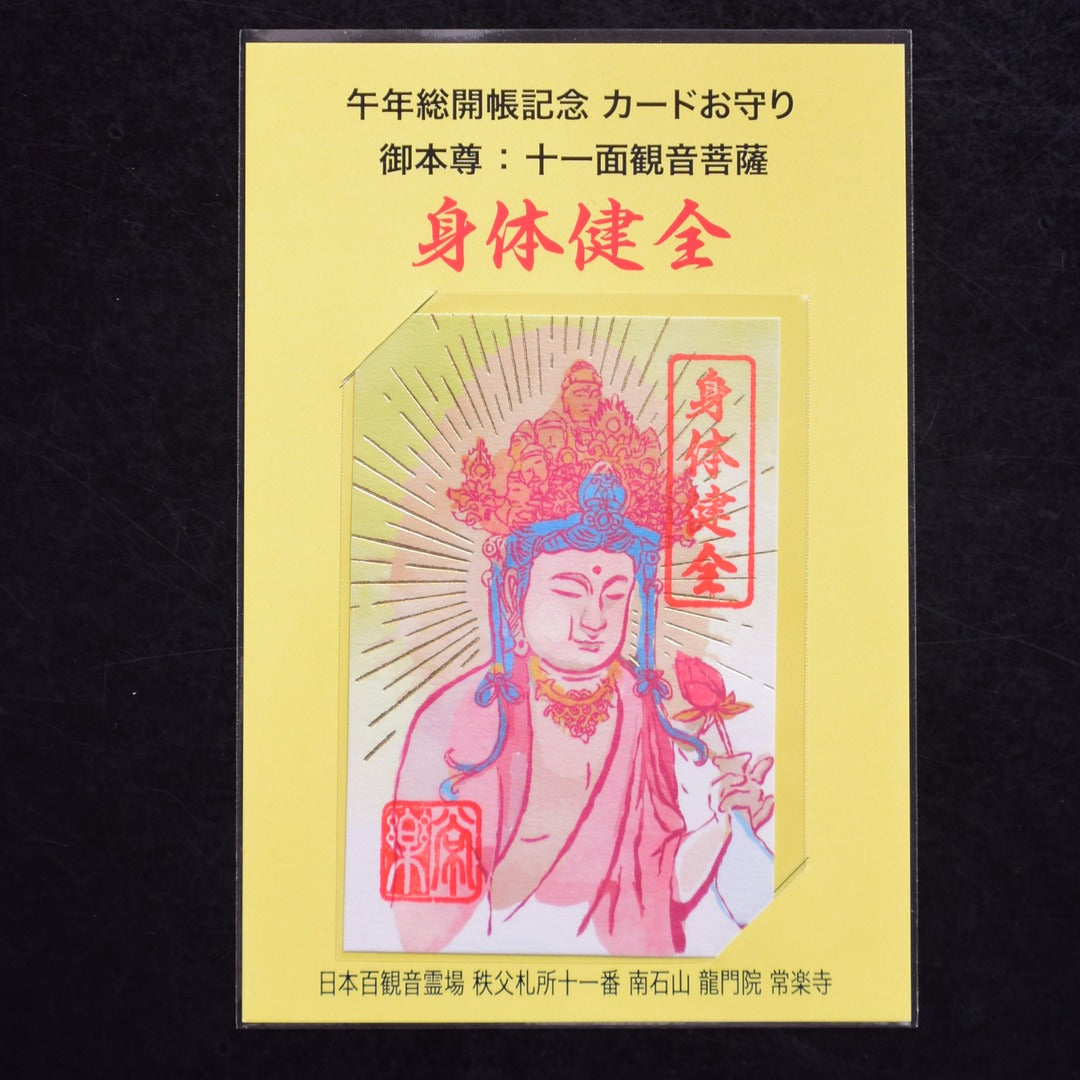
【Special Goshuin for the Year of the Horse Sōkaichō (Final Distribution)】 “Eleven-Faced Kannon” Gold Lettering & Omamori Card Set
【Special Goshuin for the Year of the Horse Sōkaichō (Final Distribution)】 “Eleven-Faced Kannon” Gold Lettering & Omamori Card Set
Couldn't load pickup availability
\Final Distribution to Commemorate the Year of the Horse Sōkaichō/
will be available from November 16 (Mon) through November 30 (Mon) as a final commemorative release for the Year of the Horse Sōkaichō.
(The Sōkaichō concludes on November 30.)
For the first time, you can also order it online as a set with the Year of the Horse Sōkaichō limited-edition Omamori (amulet) card.
Set contents (¥2,000; shipping fee charged separately)
・The date written on the Goshuin will be your order date (purchase date).
・No name or other personalized handwritten entry is included.
・Includes the Year of the Horse inscription (the Sōkaichō seal is not included).
・One of seven designs: Fulfillment of Wishes, Wealth Luck, Good Health, Family Safety, Warding off Misfortune, Ichiryū Manbai-bi, or Tensha-nichi.
One of the seven designs will be selected at random (one card will be sent).
Please place your order with this in mind.
Delivery
This is a limited quantity release and will end once sold out.
\Renewed for 2026, the Year of the Horse/
This image of Eleven-Faced Kannon was created from the statue enshrined at Joraku-ji Temple.
The Mysterious Blessing Woven by a Compassionate Gaze
Chichibu Joraku-ji Temple is alive with stories of deep faith passed down through the ages. When its founder, Saint Monk Monkai, was bedridden with illness, Eleven-Faced Kannon appeared in a dream and, through a revelation from a Kongō deity, became associated with his miraculous recovery.
With compassion for those suffering from illness, Eleven-Faced Kannon has been revered for generations as the principal image who grants long life.
The compassionate gaze shining from the eleven faces sees our suffering from every direction and reaches out to save us.
This all-encompassing protection dispels daily misfortunes, supports recovery from illness, and grants the blessing of a healthy, long life.
It continues to bring light to the hearts of many people today.
Three Great Blessings
【Warding off Misfortune】
The eleven compassionate faces of Eleven-Faced Kannon see misfortune approaching from every direction, dispel evil influences, and illuminate a pure path.
They protect us from the many difficulties encountered in daily life and bring safety and peace.
【Recovery from Illness】
Since ancient times, Eleven-Faced Kannon has been believed to have the power to heal those suffering from illness.
That compassionate gaze sees the suffering of body and mind, while its gentle healing power helps restore health and vitality.
【Prayers for Longevity】
The boundless compassion of Eleven-Faced Kannon strengthens vitality and brings healthy longevity.
Like a pure lotus rising from the water, it grants the strength to live with resilience and illuminates a peaceful, fulfilling path through life.
Chichibu Joraku-ji Temple’s Principal Image:
Radiant Eleven-Faced Kannon
The Eleven-Faced Kannon enshrined at the temple has been faithfully rendered as a seal design.
This rare Goshuin may be seen as the culmination of the Buddha’s compassion and wisdom, passed down through the ages.
The halo shines mysteriously depending on the angle of the light, like a ray of compassionate light streaming from the Buddha’s world.
The rich expressions of each of the eleven faces bring deep peace and hope to those who behold them.
Pure Lotus Blossoms in the Land of Bliss
The lotus, woven from gold and delicate pink, symbolizes the strength to overcome any hardship and live beautifully, as it blooms purely even from the mud.
Its radiance stays beside us throughout life and becomes a light that shines even through difficult times.
A Sincere Prayer in Every Goshuin
Through this Goshuin, may you encounter the Buddha’s compassion that has continued since ancient times.
We sincerely pray that peaceful hearts and healthy days will fill your lives.
Perfect as a Gift

Recommended as a meaningful gift for family and friends.
As the goshuin includes the application date, it is also cherished for birthdays and celebrations.
Goshuin is a way to connect with gods and Buddhas
Originally it was a receipt for submitting a copy of a sutra, but now it is widely accepted as proof of worship.
This is a symbol of the faith of the worshippers and has the important meaning of connecting them with the gods and Buddhas.
The red seal is a handprint to paradise
The origin of goshuin is said to date back to the Heian period.
The origin of the goshuin is said to be that at that time, temples would give them to worshippers as proof that they had dedicated a sutra (a copy of a sutra).
The goshuin stamps are stamped with the name of the temple and the seal of the principal image, and are treasured as a memento of worship and proof of faith.
The goshuincho is also said to be a "handprint to paradise."
It is said that if you show your goshuin at Enma's judgment hall, you will be able to pray for going to paradise.
For this reason, in some areas, when a person dies, a goshuincho (stamp book) is placed in the coffin.
Is there any blessing to mailing it?
The goshuin stamps you receive by mail also reflect your own faith.
Of course, it's best to actually visit the shrine.
However, there are some people who find it difficult to come due to various circumstances.
In such cases, you can deepen your connection with the gods and Buddhas even if you are far away by applying for a goshuin by mail.
When you receive a goshuin stamp that has been written with love at a temple or shrine, it is important to offer a prayer in your heart.
It is not the goshuin itself that brings good fortune, but the heart that offers prayer that brings good fortune.
Continuing from the Edo period Like a substitute
A daisan is when someone visits a shrine or temple on behalf of someone who is unable to make the pilgrimage due to old age, illness, or busy schedule.
This tradition has continued since the Edo period.
The same applies to receiving a goshuin by mail.
At Chichibu Joraku-ji Temple, the head priest and all the staff will pray wholeheartedly for those who are unable to visit, so please rest assured.
With the head priest!
Visit Chichibu Joraku-ji Temple online
*Please be careful of the volume as sound will suddenly come on.


This month's special Goshuin (temple stamp)
-
Special Goshuin for November–December “Dragon Clouds and Camellias at Sunset”
Regular price ¥1,500Regular priceUnit price per -
Special Goshuin for November–December “Dragon Clouds and Camellias at Sunset” Gold Lettering
Regular price ¥1,500Regular priceUnit price per -
Special Goshuin for November–December (Limited) “Dragon Clouds and Camellias at Sunset” Gold & Black 2-Sheet Set
Regular price ¥3,000Regular priceUnit price per -
Year of the Horse Eleven-Faced Kannon – Amulet for Protection, Healing, and Longevity –
Regular price ¥1,500Regular priceUnit price per


View previous special Goshuin (temple stamp)
-
[Chichibu, Saitama: Jorakuji Temple] Exhibition: Special Goshuin Dragon Series March "Dragon, Plum Blossoms, and White-eye"
Regular price From ¥1,000Regular priceUnit price per -
[Chichibu, Saitama: Jorakuji Temple] Exhibition: September Special Goshuin Dragon Series "Moon Viewing with Dragon and Moon Rabbit"
Regular price ¥1,000Regular priceUnit price per -
[Chichibu, Saitama: Jorakuji Temple] Exhibition: August Special Goshuin Dragon Series "Dragon, Lotus, and the Sound of Wind Chimes"
Regular price ¥1,000Regular priceUnit price per -
[Chichibu, Saitama: Jorakuji Temple] Exhibition: June Special Goshuin Dragon Series "Dragon and Hydrangea"
Regular price ¥1,000Regular priceUnit price per


